
Investors booked profits in range-bound trade, led by PSU, oil & gas, energy, infrastructure, telecom, realty, healthcare, bankex, FMCG, capital goods and power counters.

Rating agency Fitch on Tuesday downgraded the US government's top credit rating to AA+ from AAA, citing fiscal deterioration over the next three years and repeated debt ceiling negotiations. The development caused a flutter across equity markets, with most leading frontline global equity indices trading weak. Back home, the S&P BSE Sensex and the Nifty50 lost over 1 per cent each in intra-day deals to hit a low of 65,751.53 and 19,517.55 levels, respectively.

The markets will remain choppy ahead of RBI policy.

The 50-issue NSE Nifty too cracked the 10,200-mark and hit a low of 10,108.55 before finishing 104.75 points, or 1.02 per cent down at 10,121.80.

The Nifty closed at 10,335.30, down 28.35 points, or 0.27 per cent.

Longest period of price-earnings expansion in the index since 1996

Traders said falling crude prices in the global market was a big boost for the economy as it lightens the country's import bill burden, eases inflation and current account deficit concerns.

The BSE IT sector, however, failed to snap a three-day losing streak and closed around 0.14 per cent lower.

Rise in crude oil price and rally in global equities aided the sentiment

The BSE Healthcare Index is up 19 per cent as compared to BSE Sensex returns of 11 per cent during this period. Nitin Agarwal of DAM Capital highlighted this trend in a report last month. "After a sustained period of underperformance over FY21-23, the BSE Healthcare Index has once again captured the spotlight. "The recent uptick in performance has been driven by hospitals and emerging green shoots in pharmaceutical exports, particularly to the US, along with sustaining momentum in domestic branded formulations," he said.

Over the past week, the BSE benchmark Sensex fell by 465 points to 28,717.91 and logged its worst weekly loss in nearly two months.

The broader Nifty, after touching a high (intra-day) of 10,555.50 points, finished at 10,539.75, up 84.80 points, or 0.81 per cent.
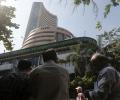
The market breadth, indicating the overall health of the market turned negative from positive

The Sensex ended higher by 245 points at 27,372 mark and the Nifty gained 66 points at 8,225.

An expectation of tax sops in Budget, weakness of dollar and robust tax collection are adding positive sentiment
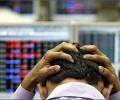
OIL, IOC, HPCL, BPCL slipped between 0.1-1.5% each while the oil producing companies such as ONGC (0.1%), RIL (1.5%), GAIL(2.6%) also edged lower.

The Budget oration of the finance minister and the confidence with which she delivered it, along with the measures and the recent upsurge in the economy would all contribute to unleashing the storied 'animal spirits' and help the economy run on the growth path quite smoothly. Or so the government hopes, notes Shreekant Sambrani.
Investors widened their bets on optimism that upcoming general budget -- to be unveiled next month - would contain incentives for corporates, which will help boost the economy

Flat Products not only has been soaring of late, but has been witnessing bounding volumes as well. From Rs 26.50 touched on 31 March, the stock price of Flat Products has risen 240.18% on sustained buying interest.

The market breadth, indicating the overall health of the market, was positive
Asian shares ended higher following a relief rally in global equities after centrist candidate Emmanuel Macron won the first round of the French presidential election.

Foreign institutional investors were net buyers in Indian equities worth Rs 277.92 crore on Tuesday

The S&P BSE Midcap and S&P BSE Smallcap indices hit a new lifetime high

Sensex surged 486 points or 1.9%.

The S&P BSE Sensex ended down 371 points at 24,966 and the Nifty50 closed 101 points lower at 7,615.
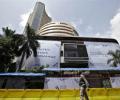
Broad-based buying aided sentiment and the market registers record turnover at Rs 6.86 lakh crore

The FPI holding in India's top 100 companies, which are part of the Nifty 100 index, declined to 24.23 per cent on average at the end of March this year, from a high of 27.5 per cent at the end of March 2021. This is the lowest FPI holdings in India's top listed companies in at least three years. A general sell-off by FPIs has weighed on stock prices and the benchmark S&P BSE Sensex is down 8.5 per cent, from its 52-week high made in October 2021. Most analysts expect FPI flows to remain weak in FY23 as well, given rising bond yields in the US and an expected earnings slowdown in India due to high inflation and commodity prices.

The 30-share Sensex is down 359 points at 26,378 and the Nifty has dropped 78 points to trade at 7,883
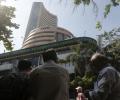
IndusInd Bank, Infosys, Maruti, Vedanta, Hero MotoCorp, Tata Motors, ONGC and RIL too fell up to 4.96 per cent.

Sentiments took a hit after broader Asian markets weakened, following a renewed sell-off on Wall Street on Tuesday as energy shares dropped after crude oil prices plunged to a 13-month low amid weak earnings and US-China trade disputes, fuelling worries about economic growth

Investors are keenly awaiting the announcement of the macroeconomic data-IIP and CPI due on Tuesday.
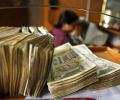
India's current account deficit narrowed sharply to just $300 million

The decline was led by index heavyweight Reliance Industries along with ITC and HDFC.

Rate-sensitive sectors like banks, realty and auto witnessed heavy selling pressure ahead of the RBI Monetary policy which is scheduled on September 29.

Brokers hope of a stable government after elections and signs of economy returning to growth path.

In the Sensex pack, Tata Motors was the biggest loser, shedding 3.29 per cent, followed by ICICI Bank, IndusInd Bank, Infosys, HCL Tech, Axis Bank, TCS, HUL, Asian Paints, Sun Pharma, SBI, Tata Steel and NTPC, which dropped up to 3.23 per cent.

The US FOMC concludes its two-day meeting today while the Bank of Japan will start its two-day meeting today.

Among the Sensex 30 stocks, new entrant Sesa Goa soared 22 per cent to Rs 187, while TCS rose 11 per cent to Rs 2,023.

Sharp fall in capital goods production and manufacturing activity also dented sentiments.
A sub-division in the face value of equity shares -- from a higher to a lower denomination
